How Do I Know If My Roof Needs Repair or Full Replacement?
A leak shows up, and suddenly you’re facing a decision worth thousands of dollars — repair the problem area, or replace the whole roof? Get it wrong in either direction, and you either waste money on a roof that needed full replacement anyway, or overspend replacing a roof that had years of life left.
Here’s how to make that call accurately, based on age, damage pattern, and inspection findings — not guesswork.
The Problem: Most Homeowners Decide Based on Fear, Not Evidence
A single leak often triggers an emotional “just replace the whole thing” reaction — or the opposite, a “patch it and hope” approach that ignores a roof nearing the end of its life. Both decisions, made without a proper inspection, frequently cost more long-term.
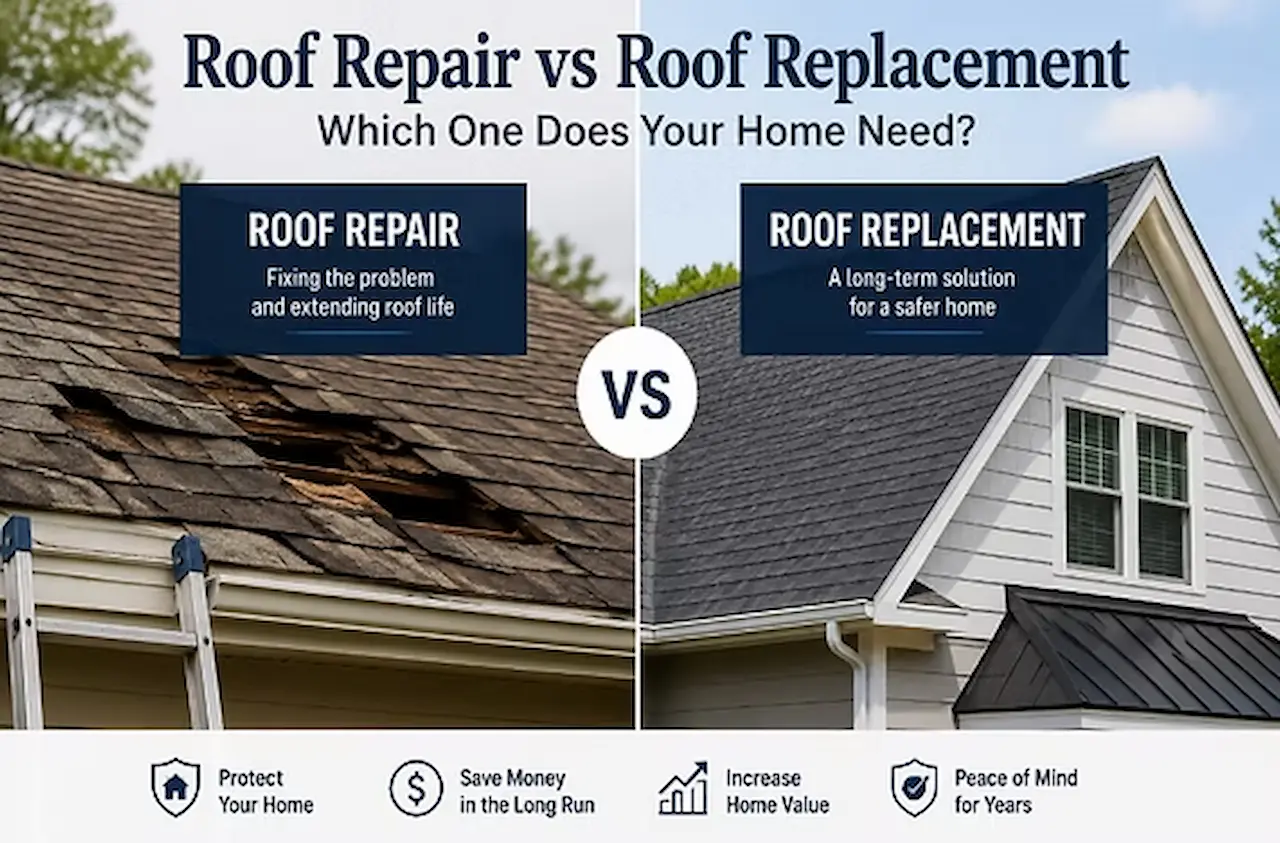
Roof Repair vs. Replacement: Quick Comparison
| Factor | Repair Makes Sense | Replacement Makes Sense |
| Roof age | Under 15 years (asphalt) | 20+ years (asphalt) |
| Damage extent | Localized (1-2 areas) | Widespread across multiple sections |
| Leak history | First occurrence | Recurring leaks in different spots |
| Shingle condition | Isolated curling/missing | Widespread granule loss, curling |
| Cost | $300 – $1,500 typical | $9,000 – $20,000+ typical |
Step-by-Step: How to Diagnose Repair vs. Replacement
Step 1: Check your roof’s age against material lifespan. Asphalt nearing 20-25 years is a strong replacement signal, even without visible damage yet.
Step 2: Assess damage spread, not just severity. One damaged area = likely repair. Damage in multiple, unrelated sections = sign of system-wide failure.
Step 3: Look for granule loss in gutters. Heavy granule accumulation indicates shingles are breaking down across the roof, not just at the leak point.
Step 4: Review your leak history. A single new leak after a storm is different from recurring leaks in different locations over 1-2 years.
Step 5: Get a professional inspection before deciding. A trained eye can spot underlayment failure or deck damage invisible from the ground — this is the single most reliable diagnostic step.
Real-World Example
A homeowner in Tigard noticed a small ceiling stain and assumed it needed a simple patch. A professional inspection revealed the asphalt roof was 22 years old, with granule loss across multiple roof sections and early underlayment failure in two additional areas not yet visibly leaking.
A targeted repair would have cost roughly $800 but likely required 2-3 more repairs within 18 months as the rest of the roof failed. Full replacement at $13,000 instead solved the underlying age-related issue once, rather than repeatedly treating symptoms of a roof at end-of-life.
Pros and Cons of Each Option
Repair
- Pros: Lower upfront cost, faster turnaround, ideal for younger roofs with isolated damage
- Cons: Doesn’t address system-wide aging, can become a recurring expense if root cause is roof age
Replacement
- Pros: Resets your roof’s full lifespan, addresses all underlying issues at once, often comes with warranty coverage
- Cons: Higher upfront cost, longer project timeline
Common Mistakes Homeowners Make
- Repairing a roof that’s already past its expected lifespan, leading to repeat repair costs
- Replacing a roof with isolated, repairable damage out of fear rather than evidence
- Skipping a professional inspection and relying only on visible, ground-level damage
- Ignoring granule loss in gutters as an early warning sign
- Not checking insurance coverage before deciding — storm damage may be covered differently than age-related wear
FAQs
1. How do I know if my roof needs a full replacement?
Key signs include roof age over 20-25 years (asphalt), widespread granule loss, recurring leaks in different areas, and visible sagging.
2. Can a roof be repaired more than once?
Yes, but repeated repairs on an aging roof often signal it’s more cost-effective to replace rather than continue patching.
3. How much does a typical roof repair cost?
Localized repairs typically range from $300 to $1,500, depending on damage extent and material.
4. Is roof replacement covered by homeowner’s insurance?
Often partially, if the damage is from a covered event like storm or wind damage — age-related wear is typically not covered.
5. How long does a roof replacement take?
Most residential roof replacements take 1-3 days for asphalt, slightly longer for metal or flat roofing systems.
6. What’s the average lifespan of a roof before replacement is needed?
Asphalt: 20-25 years. Metal: 40-70 years. Flat roofing: 15-25 years.
7. Can I repair just one section of my roof instead of replacing the whole thing?
Yes, if damage is isolated and the rest of the roof is structurally sound and within its expected lifespan.
8. What are signs of roof damage I can check myself before calling a professional?
Missing or curling shingles, granules collecting in gutters, visible sagging, and water stains on interior ceilings.
9. Does a small leak always mean I need a full roof replacement?
No — a single, isolated leak on a younger roof is often a straightforward, inexpensive repair.
10. How often should I get my roof professionally inspected?
Annually, or immediately after major storms, especially for roofs over 15 years old.
Conclusion: What to Do Next
Repair vs. replacement isn’t a guessing game — it comes down to roof age, damage spread, and a professional inspection. Making this decision based on evidence, not fear, saves both money and future headaches.
Not sure which option fits your roof? Request a free roof inspection to get a clear, honest recommendation in writing.